
James Prescott Joule
The first law of thermodynamics owes much to J.P. Joule who, during the period 1840-1849, carried out a series of experiments to investigate the equivalence of work and heat. In one of his experiment, Joule used an apparatus similar to the one shown in figure below.

Let us consider a closed system which consist of a known mass of water, (m) contained in an adiabatic vessel having a thermometer and a paddle wheel as shown in figure above.
Let a certain amount of work (W1-2) be done upon the system by the paddle wheel. The quantity of work can be measured by the fall of weight which derives the paddle wheel through a pulley.
The system initially was at temperature (t1), the same as that of the atmosphere and after the work transfer let the temperature rise to (t2).
[NOTE :- The pressure is always 1 atm.]

The process 1-2 undergone by the system is shown in the figure 4.2, in generalised thermodynamic coordinates X,Y.
[Let the insulation now be removed.]
the system and the surrounding interact by heat transfer till the system returns to the original temperature (T1), attaining the condition of thermal equilibrium with the atmosphere.
The amount of heat transfer (Q2-1) from the system during the process (2-1) shown in the figure above, can be estimated from,

The system thus execute a cycle, which consist of a definite amount of work input (W1-2) to the system followed by the transfer of an amount of heat (Q2-1) from the system.
NOTE :- (W1-2) is always proportional to the heat (Q2-1) and constant of proportionality is called the Joule's equivalent or mechanical equivalent of heat.
If the cycle involves many more heat and work quantities, the same result will be found,

where J is the Joule's equivalent. This is also expressed in the form
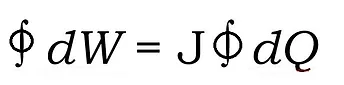
where the symbol ∮ denotes the cyclic integral for the closed path.
This is the first law for a closed system undergoing a cycle. It is accepted as a general law of nature, since no violation of it has ever been demonstrated.
In the S.I system of units, both heat and work are measured in the derived unit of energy, the joule. The constant of Proportionality, J, is therefore unity (J= 1 Nm/J).

